Reporter's Notes for first-person experience
At 3 pm, in a script-killing game store, a man clad in ancient Chinese costume led me into a private room. The lights were dim while traditional Chinese-style background music played on a loop, he lit a candle, and called out to me, "Ailian, my daughter."

A roughly 15-square-meter room styled in traditional Chinese fashion, with a city‑wall patterned curtain at its center that slides open and closed to separate players from the DMs. After players finish reading each scene, the DMs step out from behind the curtain to perform collectively with the players.
This was my first ever encounter with a romantic companion script. The role assigned to me via a 10-question personality quiz on Qiandao app (China's dominant script-killing platform) was Ailian, the "father-companion" role in the script, guaranteed a dedicated DM who would play my overindulgent merchant father for the entire 9-hour session.
As I walked towards the room, I watched two girls stumble out of other rooms, gasping through heaving sobs, their makeup completely ruined. In another corner, a DM held a female player’s hand, dabbing away her tears and murmuring soft words of comfort.
The cost was 368 yuan per person, including hair and costume styling. I put on the shop’s ancient costume, had my hair styled in a traditional updo by a make-up artist, and sat in the ancient-style theater. As I flipped open the first page of the over 200-page script, I realized the quiz had not matched me to my personality—it had matched me to my deepest unspoken fantasy: a life where I was unconditionally loved, and never wanted for anything.


Most shops offer free makeup and costumes to enhance the player's immersive experience.
Two of the fellow players in my session had also traveled from Hong Kong. They said identical sessions in HK run 650 to 700 yuan—nearly double the price—with far fewer script options and less polished DM performances. They make the cross-border trip at least five times a month.
One of the Hong Kong girls was our "front runner", the session organizer, and the primary companion role player. A veteran of 40+ companion scripts, she had paid 100 yuan subsidies to three secondary role players, including my boyfriend, to fill the car. This is standard industry practice that players will pay out of pocket to ensure their session runs.
Her in-game lover, a tall, soft-spoken male DM, took her hand the second she walked through the door, tied a red silk string around her wrist, and never left her side for the next nine hours. He fed her snacks during breaks, held her when she cried, and whispered lines only she could hear.
What truly shocked me was the DM was playing her character's biological younger brother. In the industry, this trope is referred to as "orthopedics", a Chinese internet slang term for incestuous romance.
I asked if this was permitted, the DM said, "It’s explicitly banned, but we run it on the down low." The female player told me she’d played several similar scripts. "Some people just eat this up," she said.
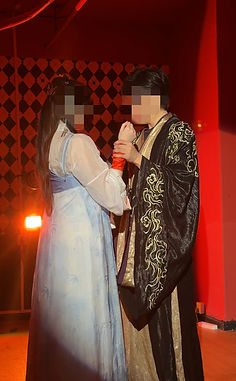


The interactions between the romantic companion roles and the DM, including holding hands, exchange the token of love and hug,


The script was divided into two volumes, with strict instructions to stop reading at marked pages. At first, I kept my distance, self-conscious about acting out emotional scenes with strangers. But the writing slowly drew me in — right up until the first time I was called into a separate room, face to face with the DM playing my father.
To be honest, I felt awkward at first, because I knew he was just acting. But he was so convincing, like he’d stepped straight out of the pages of the script, speaking every line with such doting affection. He pressed a jade pendant into my palm and told me he and my mother crafted each dowry since I was born to give me the perfect wedding. As I looked into his eyes, I actually found myself believing that this man in front of me was my father.
Back from the separate room, the session began the first pubic performance which is a lighthearted "fun segment", an essential part of every script designed to break the ice between unfamiliar players. We ad-libbed our way through an auction scene, yelling bids and teasing each other to break the tension.
Later, as our characters waited for sunrise on a mountaintop, a DM pulled out a wooden sign painted with "Yes" and "No". He made the companion player and her brother-DM stand inches apart, answering questions by leaning their faces toward one side or the other. On the final question, the DM dropped the sign, suddenly lean in and tackled her to the ground to have an intimate hug, which is an unscripted moment.
All scripts are typically divided into two volumes. Each volume is further divided into several acts. After reading each act, players are assigned individual tasks that they need to complete while the DMs enter the room to conduct group performances. Players are strictly prohibited from reading ahead to the next act.
After the joy, the story took a tragic turn, and the script hit its emotional peak. I told myself it was all fake. However, as I watched the DM’s heartfelt, vivid performance, as every line he spoke landed exactly on the parts of my life I’d always felt were missing, I couldn’t hold back my tears.
What truly broke my heart wasn’t Ailian’s story, but the way it held all the emotions I’d hidden away for so long — the people I’d lost, the words I’d never dared to say, the grief I’d carried locked up inside me.
But after the immersion faded, my rational instincts kicked back in. When the plot reached the point where my beloved father had to die to save me, I didn’t cry. The DM’s performance was flawless: he waved a tattered military flag, shouted his final words over the roar of pre-recorded fire, and even lit a small controlled flame in the corner of the black room. It wasn’t that I wasn’t moved — I just couldn’t understand why he had to die at all.
There was a clear plot hole here: his death felt like nothing more than forced sentimentality. The same flaw appeared in the plot twist: why did we have to hurl cruel words at another player during the wedding scene? There was no build-up, no motivation, only raw emotion forcing the characters forward.
The session ended at midnight. The shop charged us an additional 15 yuan per person in overtime fees, beacuse an additional 15 yuan will be charged per hour after 12 am. As we filed out, Yunyi’s player—who had spent the last three hours sobbing uncontrollably—mumbled, "This just proves sincerity gets you nowhere in love."
Stepping out of the venue, I found myself cherishing my boyfriend more than before, unable to help but see him through the lens of "Yongkang", the character he’d played as my in-game romantic partner. In that moment, who was he really — himself, or the man from the script?
All those girls sobbing until they could barely breathe, all those players who’d traveled so far to be here — they were spending their hard-earned money and time to buy something increasingly rare in real life: the feeling of being unconditionally and unwaveringly loved, even if only for nine hours. It is a feeling that has become increasingly rare in real life, and the script-killing industry has turned it into a perfectly packaged, 368-yuan commodity.
This was my first time, and will almost certainly be my last. Not because the experience was bad, but precisely because it was too good. So good that for a moment, I truly believed the man in that black room was my father. So good that even after leaving the venue, I couldn’t help but see my boyfriend through the filter of his character.
But when I stepped out of Ailian’s shoes and back into myself, I thought those carefully crafted emotional peaks in the script, those flutters of the heart and floods of tears brought on by the DM’s professional performance, were ultimately nothing more than a commodity with a clear price tag. Real-life companionship, awkward, unremarkable, and unpolished, needs no actor to bring it to life.